Portugal's Carnation Revolution
The Dictator that "Falls" from Ruling the Country to the Kitchen,
The Fearless General and the Revolution
Chapter - 1
Beginning of the Dictatorship
Oppression, press censorship, state’s close affiliation with the clergymen, restrictions to the rights and liberties of the people…
And one man in the centre of all these: António de Oliveira Salazar.
As in many other countries where people regained their liberties upon rising against the long-standing tyranny, oppression and servitude, behind Portugal’s road to freedom, lies a struggle that is filled with sacrifices, valour, and fearless heroes.
A struggle that is easier said than done, memories of which are weighing on the hearts; but in the end, a rewarding one.
Everything started with a spatula.
Yes, you’ve read it right.
Spatula, the one that we use daily in our kitchens.
When I entered kitchen in Portugal, I learned that what we call spatula is called “Salazar” by Portuguese.
They had given the name of the dictator who ruled the country for almost half of a century, to this plain utensil used in the kitchen.
Why, though?
My curiosity got the better of me and I set after this story.
What I discovered throughout my research, sometimes chilled me to my bones, sometimes excited me and sometimes filled me with sorrow.
Are you ready to take this staggering travel in time with me?
Then buckle up.
(A quick, friendly recommendation: As you might have understood, this is not one of those classical travel articles. So, get your coffee (or any beverage of your choice), lay back and get ready to embark on a journey full of emotions, towards Portugal’s fascinating story of fight for freedom.)
Today is 25th of April. The Independence Day in Portugal.
Everywhere is decorated with carnations. Because with the Carnation Revolution that took place on April 25, Portuguese, paved the way to their freedom.
But how did Portugal get drifted towards this aftermath? Why did Portuguese have to give a fight for their freedom? What sacrifices have been made throughout the road to freedom?
And why is it called Carnation Revolution?
I started researching the impressive story of the Revolution after stumbling into it by chance in Portugal and found out that it was something which we all could learn from. Therefore, to bring this story out in the best way possible, I dug into it for almost two years.
And decided to publish it on this 25th of April, anniversary of Carnation Revolution.
Lisbon Regicide
Portugal Falls into the Hands of a Dictator
As you may know, Portugal used to be ruled as kingdom. At least until the 20th century.
In 20th century, however, we see “First Republic” period.
Short in lifespan, the 1st Republic has been terminated with a revolution which included a regicide in 1908. During their passage through the Praça do Commerçio (also known as Terreiro do Paço) the royal family was attacked by assassins. In the course of this event, which is known as the Lisbon Regicide, the King of Portugal and heir Prince were killed and thus the Portuguese Monarchy was overthrown.
Having been founded upon such a turmoil The First Republic failed to have a well-grounded structure and therefore could not last long.
As mentioned above, the First Republic had a very short life.
Indeed, the coup d’etat that took place in 1926, brought a swift end to the First Republic and made the way for a period that would deeply affect Portuguese’s lives and always be remembered with mostly sad and painful memories:
The “Ditadura Nacional” (‘National Dictatorsip’) period.
Thus began the difficult journey to the Revolution.
In 1933, upon the constitutional referendum, National Dictatorship was transformed into a regime called “Estado Novo” (“New State” in English) with a system developed by António de Oliveira Salazar, back then the Minister of Finance, for which he took conservative and autocratic (where a state or society is governed by one person with absolute power) ideologies as example.
And he assumed the posts of head of government and prime minister in this regime that would last for 41 years.
(By the way, if the name “Salazar” reminded you of the villains in world-famous series such as Harry Potter and the Pirates of the Caribbean, it is for a reason. Keep reading to find out why =))
What Is the "Salazar Regime"?
Although Portuguese people appreciate some of Salazar’s works, the only word they mostly use to describe his rule remains the same:
DICTATORSHIP.
Before moving on to why people consider him a dictator, let’s give the credit where it’s due and address some of his remarkable works, shall we?
1- His Success In Financial Matters
Salazar, ever since his school years, shows the signs of his brilliance in financial matters. And when he was eventually appointed as Minister of Finance, he had some significant accomplishments for Portuguese economy, such as raising the GDP per capita. (Although it was not enough and Portugal still remains to have the lowest average of salary in Western Europe.)
Of course, when Salazar’s educational background is considered, his success in financial politics is not a surprise. He graduated from the Coimbra University Faculty of Law with honours, specialising in Finance and Economic Policy.
{Coimbra University is the oldest in Portugal and one of the oldest in the World. Visit the city of wisdom: HERE}
2- Literacy Rate Goes Up In Portugal
During his rule, education has been handled as a priority matter.
Many schools were built, many universities opened (not only in Portugal but also in the old colonies like Mozambique and Angola) and literacy rates of the children at the primary school age had reached to 100%. (Here again, Portugal still remained to have the lowest literacy rate in Western Europe.)
3- He Kept Portugal Harmless -If Not Profited- During the WWII
One accomplishment that Portuguese people mention mostly about Salazar was Portugal’s attitude during the WWII.
As you might notice, Salazar’s rule coincides with the breakout of the 2. World War.
They say that Salazar kept Portugal neutral during the WWII and he used the occasion to the Portugal’s benefit instead.
How?
By selling materials -such as tungsten- that are important in the war time to the state-parties; which contributed highly as an income to the Portuguese economy.
There Is A Controversy, Though, About Portugal’s Neutrality.
Portugal’s neutrality bears some controversies, though.
Some scholars say that Portugal’s neutrality had actually been in favour of some certain countries such as the UK and the USA. (Let me remind you that Portugal and UK are the oldest allies in the World.)
The scholars who assert the foregoing opinion emphasize that Portugal allowed U.S. to use the Azores as airbase. For the US aircrafts that passed Atlantic and needed fuel charge to continue their mission, these islands in the middle of the Atlantic were of a big help, which naturally provided significant upper hand to the allies. But let’s leave this discussion to the academicians.)
Then, despite all these, why do people consider his rule a dictatorship?
Let’s check up on that.
Why Salazar Regime Is Considered a Dictatorship?
Because the other side of the medal is not so bright.
During his rule, fundamental and political rights and freedoms were restricted to a large extent. Such as those of the press, thought and expression, assembly and demonstrate, thought and faith… and many more.
A secret and political police agency was established, which later became an armed special force of the Estado Novo and the government implemented a strict censorship policy throughout the country:
“PIDE”.
P.I.D.E.; ‘Polícia Internacional e de Defesa do Estado’(The “International and State Defence Police) was actually formed to maintain the security of the country.
It is, however, used for controlling the society and reinforce the oppressive regime upon people. Those who raised voice against the government said to have been detained, some of them were tortured and killed. As a result of which, eventually, the community became afraid to talk.
(If you want to take a shuddery time travel to these years, I highly recommend you visit Aljube Museum of Resistance and Liberty in Lisbon. To visit now: HERE.)
You may question: “But wasn’t Salazar just the prime minister? Did not Portugal have a president? Why was he so capitulated?”
Because Salazar was a highly regnant political figure and, as the phrase goes, able to “pull the strings” at his will.
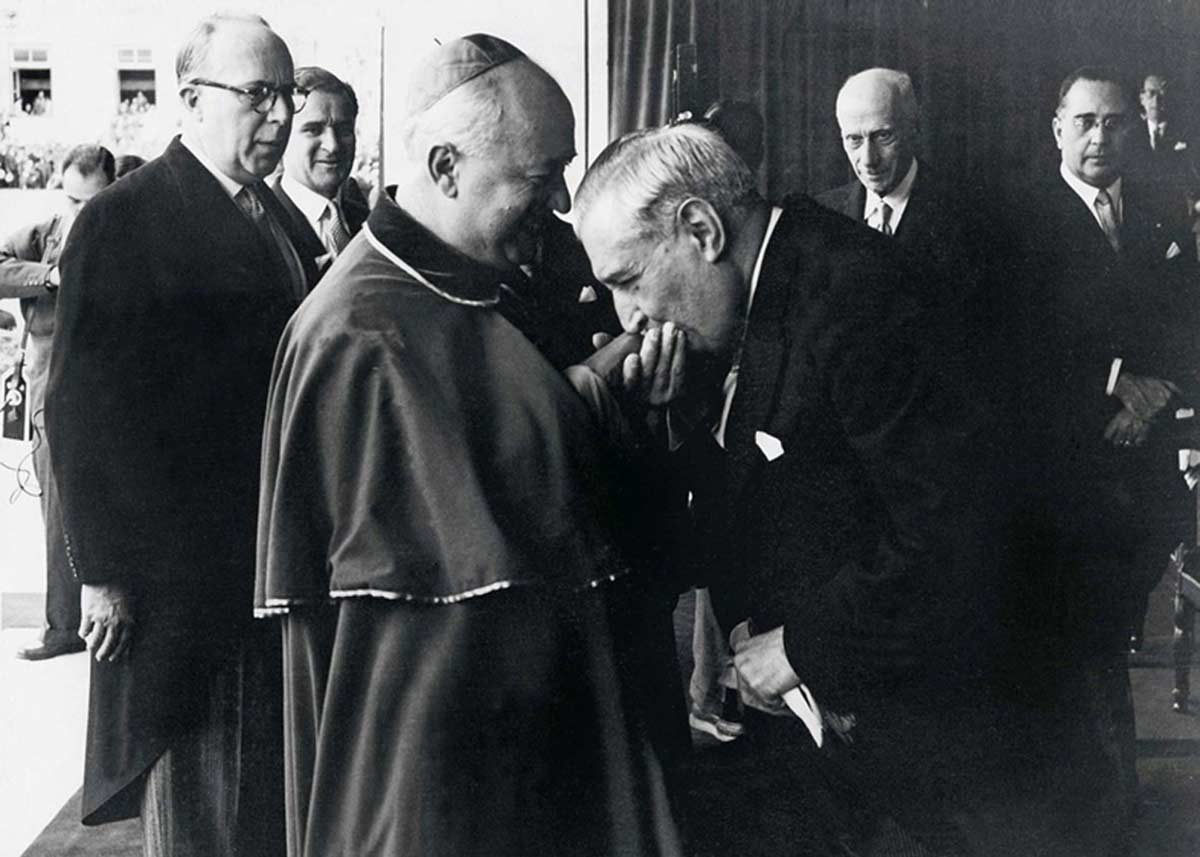
Before steering towards the faculty of law, Salazar wanted to be a cleric and finished Seminary of Viseu. And not so surprisingly, after he went into politics, remained in close proximity to clergymen and Catholic institutions. (One of his closest friends was Cardinal-Patriarch Cerejeira, who later had become the head of the Catholic church and been involved in many important political decisions).
Though Meneses stresses out that Salazar left behind his earlier political Catholicism later on and he governed not in accordance with Church’s interest but with what was “national” according to him.

(According to the biography of Salazar by historian-academician Filipe de Meneses, upon negotiations with the Church, (the head of the church was Cardinal Cerejeira, his old friend) State accepted establishment of religious orders and congregations.
One of them was Acção Catolica Portuguesa, which had a very complex structure, having many different sub-divisions structured according to age (adults, youth, childhood); sex (men, women separately); working class, universities…) and so on.
Also, through “Christianization” of education, and later through an agreement with the Church (the “Concordat of 1940”), Salazar provided necessary conditions for the Church to act freely upon the social, cultural and moral matters and have a hold upon the society.
A photo of Salazar’s Meeting with the Pope
These Were Not the Only Questionable Events in Salazar’s Rule
Package Constitution, Presidential Government and Sweeping Powers
As you may guess, Salazar’s rule had some more questionable events. For example, the 1933 Constitutional Referendum.
The committee that is established by Salazar, consisting of lawyers, clerics, businessmen and academicians prepared a constitutional draft which was submitted to referendum in 1933.
The referendum, which also paved the way for Estado Novo, has been acclaimed by majority of the votes. But don’t be fooled by this number. Because in the voting, the abstention votes had been accepted as “yes” and the constitution had been presented as a package deal. Which means that the voters had to say “yes” or “no” with no opportunity to accept one clause and reject the one that they don’t approve.
One positive development could be that, women had been entitled to vote for the first time. However, they had been subjected to condition of having secondary education, whereas men only needed to be literate to vote. (Considering that literacy levels had been very low in Portugal, how positive this development was can be open to discussion.)
The constitution that was approved entitled the president with sweeping powers that would render him almost untouchable, above everything. One of the powers that President was furnished was to appoint and dismiss the prime minister.
You may ask now; “But was this not against Salazar’s benefit? Why would he allow that?”
Although, in appearance, president held the powers; behind the curtain, it was Salazar who had the control and all the presidents that took the office gave Salazar a great elbow room.
Of course, Salazar, was not yet aware that one day, a very brave man would take heart from this new power, to take a stand against Salazar, and become one of the biggest initiators of the resistance.
General Humberto Delgado…
Humberto Delgado, who would go down in history as the Fearless General, would put his life on the line; and with his dauntless opposition campaign would ignite the fire of long-awaited freedom within Portuguese people’s hearts thus opening the way for the Carnation Revolution.
TO BE CONTINUED Buraya Tık…
Lisbon Ultimate Travel Guide
Yellow nostalgic trams, cobblestone streets and colorful houses… Check out this extensive guide to get to know this vibrant city, Lisbon >>>
Mystery Behind Nazaré’s Giant Waves Explained
Renowned for their sheer enormity and raw power, Nazaré’s waves can reach staggering heights during peak swells and stand as some of the largest and most formidable waves on the planet. But how do these giant waves occur? Find out here >>>
Manastırlardan Sokağa Taşan Lezzet: Portekiz’in Geleneksel Sarı Tatlıları
Portekiz tatlı kültürünün manastırlarda şekillendiğini biliyor muydunuz? Peki ya Portekizliler için vazgeçilmez olan bu lezzetlerin neden hep sarının binbir tonunda olduğunu?
The Oldest House in Lisbon That Survived The Great Earthquake of 1755
500 year-old house, stands as a testament to the Lisbon’s enduring history in the heart of the second oldest neighbourhood of Europe, Alfama.
One Comment